On May 22, 2026, NewsNation published "NXIVM whistleblower: Kellen was a victim before she was a co-conspirator."
This piece is a rigorous analysis of that article.
When Sarah Kellen testified before the House Oversight Committee last week, NewsNation reached for a comparison. The Epstein story is, by now, a known shape: documented predation across decades, a 2007 non-prosecution agreement, a list of "potential co-conspirators," and the durable difficulty of deciding what to do with the women whose names appear on it. Kellen's testimony — that she was abused for over a decade and named three new figures previously unknown to the committee — fits into that shape recognizably.
The piece could have rested there. Instead, it reached across to NXIVM.
Halfway through the article, under the header A pattern survivors recognize, NewsNation introduces Jessica Joan — "Jane Doe 2" in the federal case against Keith Raniere — to comment on Kellen. The framing is gentle and the language is qualified:
"There's a lot of nuance to it. When you're dealing with high-level traumas or whatever different kind of neurosis or psychopathy, and then you're being groomed, and your safety might be compromised, there are ways people can do these things that are awful."
— Jessica Joan, quoted in NewsNation, May 2026
But the move is clear. Joan is being positioned as a parallel survivor whose authority transfers onto Kellen's situation.
There is nothing wrong, in principle, with comparative survivor testimony. The trouble begins when the comparison is doing the work that examination should be doing — and when the underlying record of the comparison has not been checked.
The shape of the comparison
The piece tells the reader, in flat declarative prose, that NXIVM "was engineered to lure women through strategic manipulation" and that, like Epstein's network, it "weaponized victims to keep them quiet." These are not attributed sentences. They are presented as settled facts of the matter.
If they are settled, they're settled the way most public narratives about famous cases get settled: by repetition. The actual trial record — transcripts, sentencing rulings, the government's own closing arguments — is more contested than the comparison implies. The specific record behind Joan's case is more contested still.
What Count 10 actually was
Joan testified as "Jay" at trial. Forty years of Raniere's 120-year sentence rest on Count 10 — attempted sex trafficking of Jay. Those words carry weight. It's worth asking what conduct, exactly, they're labeling.
On Joan's own direct examination, the assignment underlying Count 10 was this: Allison Mack told her to ask Raniere to take a nude photograph of her, in what the group referred to as a "seduction assignment." She refused. She never asked him. She left the group shortly after. Nothing else occurred.
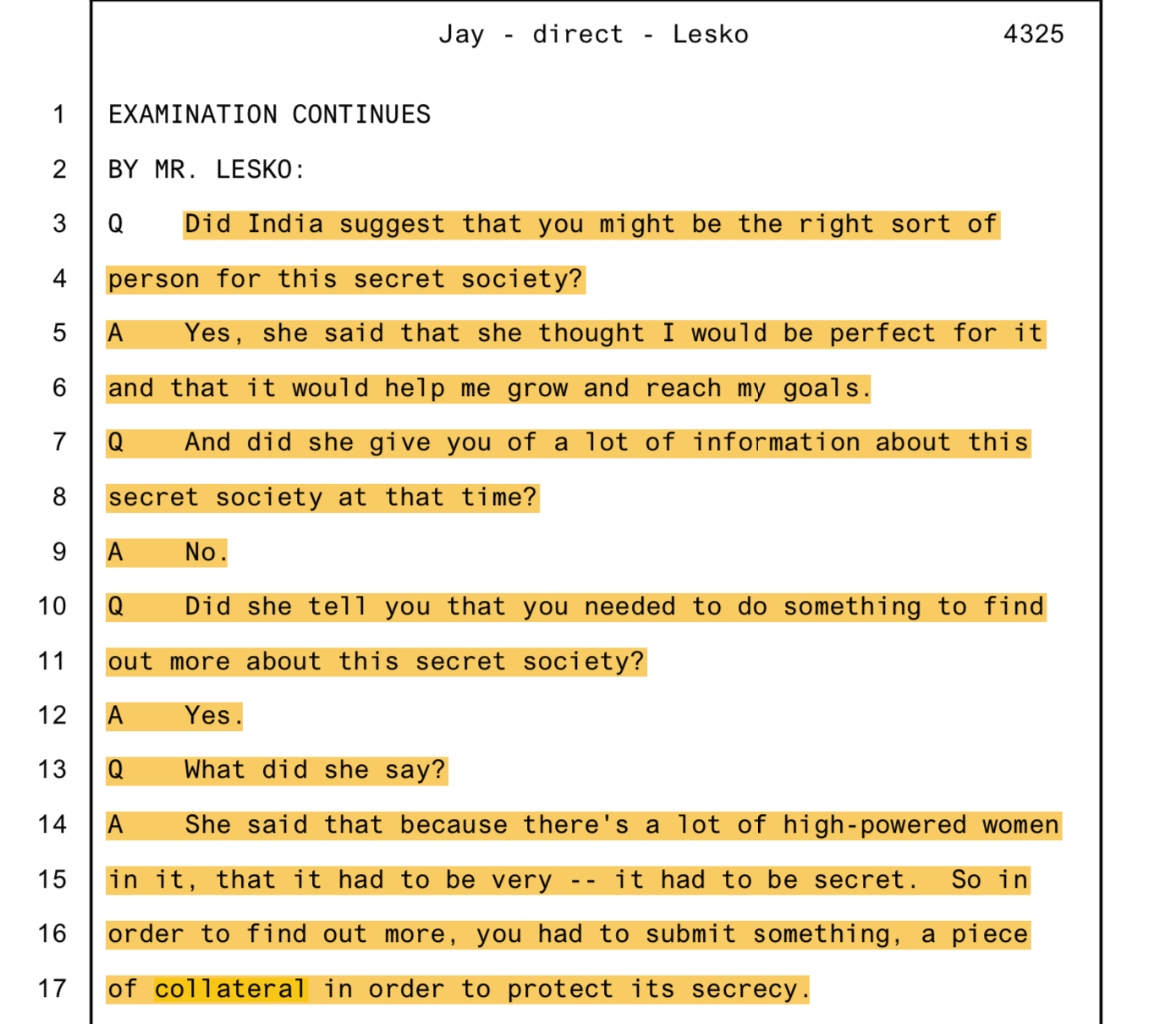
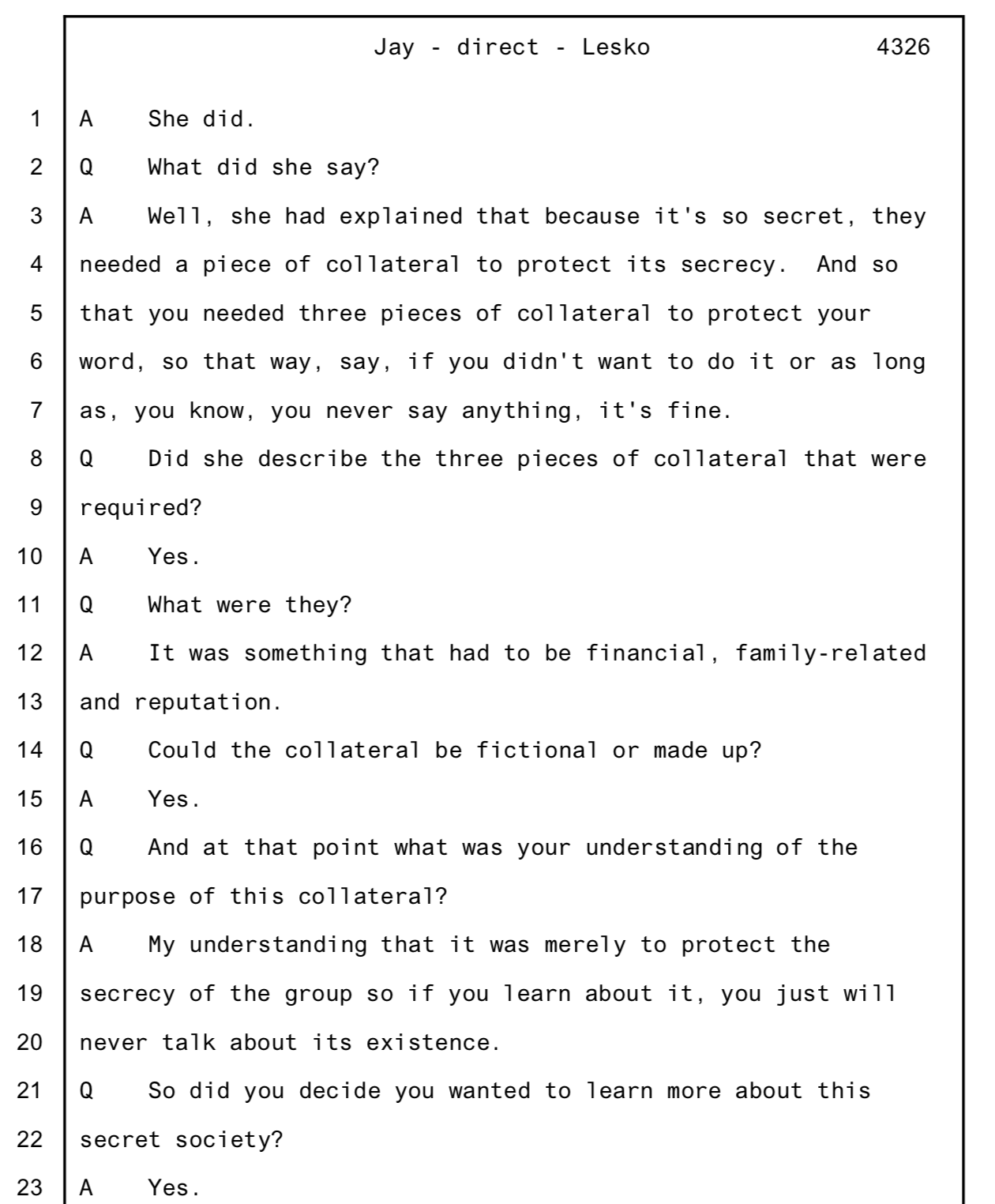
As reported
"NXIVM was engineered to lure women through strategic manipulation" and "weaponized victims to keep them quiet."
In the record
"My understanding [was] that it was merely to protect the secrecy of the group, so if you learn about it, you just will never talk about its existence."
To bring Count 10 in federal court, the government needed three things: interstate commerce, a "thing of value" exchanged for a sex act, and coercion. Each was a stretch.1
The interstate-commerce hook was Joan's flights between California and New York. But Joan herself testified, on direct, that the travel was for her own modeling work, "because I couldn't make money in Albany" (Tr. 4343–4344).
The "thing of value" wasn't money or goods or any tangible benefit. The prosecution's closing told the jury it was the social standing Mack would gain by "making Raniere happy" (Tr. 5414).
The coercion element rested on Joan's mere membership in DOS — a group that was not itself charged as the criminal enterprise.
The most striking line in the record is not in the trial. It is in the sentencing.
This is not a defense of Raniere. It is a description of the record on the count Joan's status as a "sex-trafficking survivor" rests on. Anyone leaning on that status to interpret a Kellen story has, at minimum, an obligation to look at the count.
What was also in the record
The trial record has details the NewsNation piece doesn't have room for — and that don't fit inside the word survivor as the piece uses it.
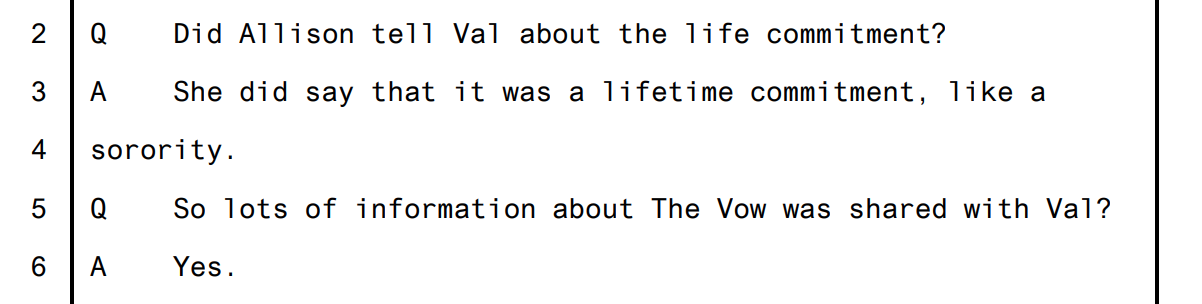
Joan testified that she introduced another woman, "Val," to the group. She flew to Vancouver with her. She recruited her into "The Vow." She described Val as enthusiastic. And she confirmed Val had been told it was a lifetime commitment.
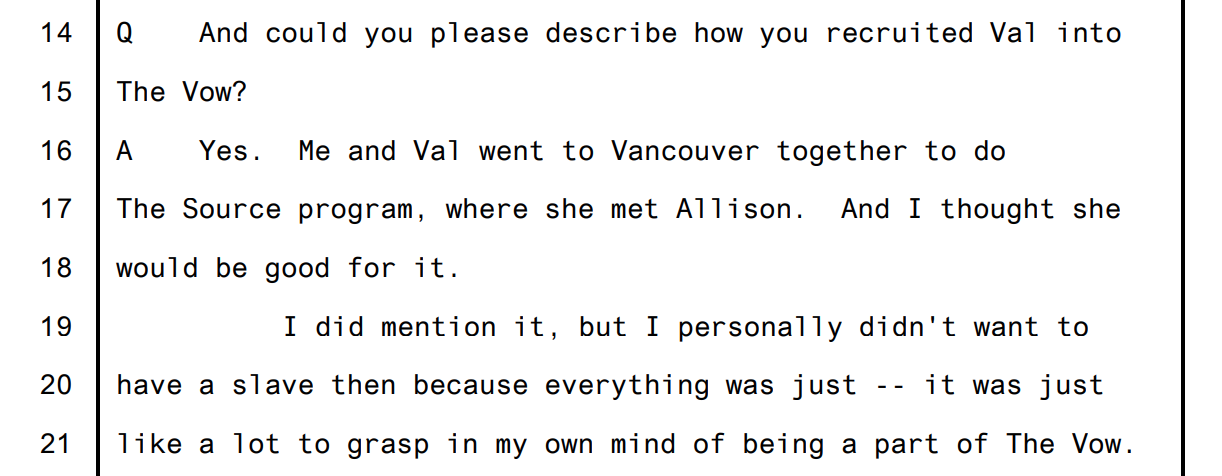
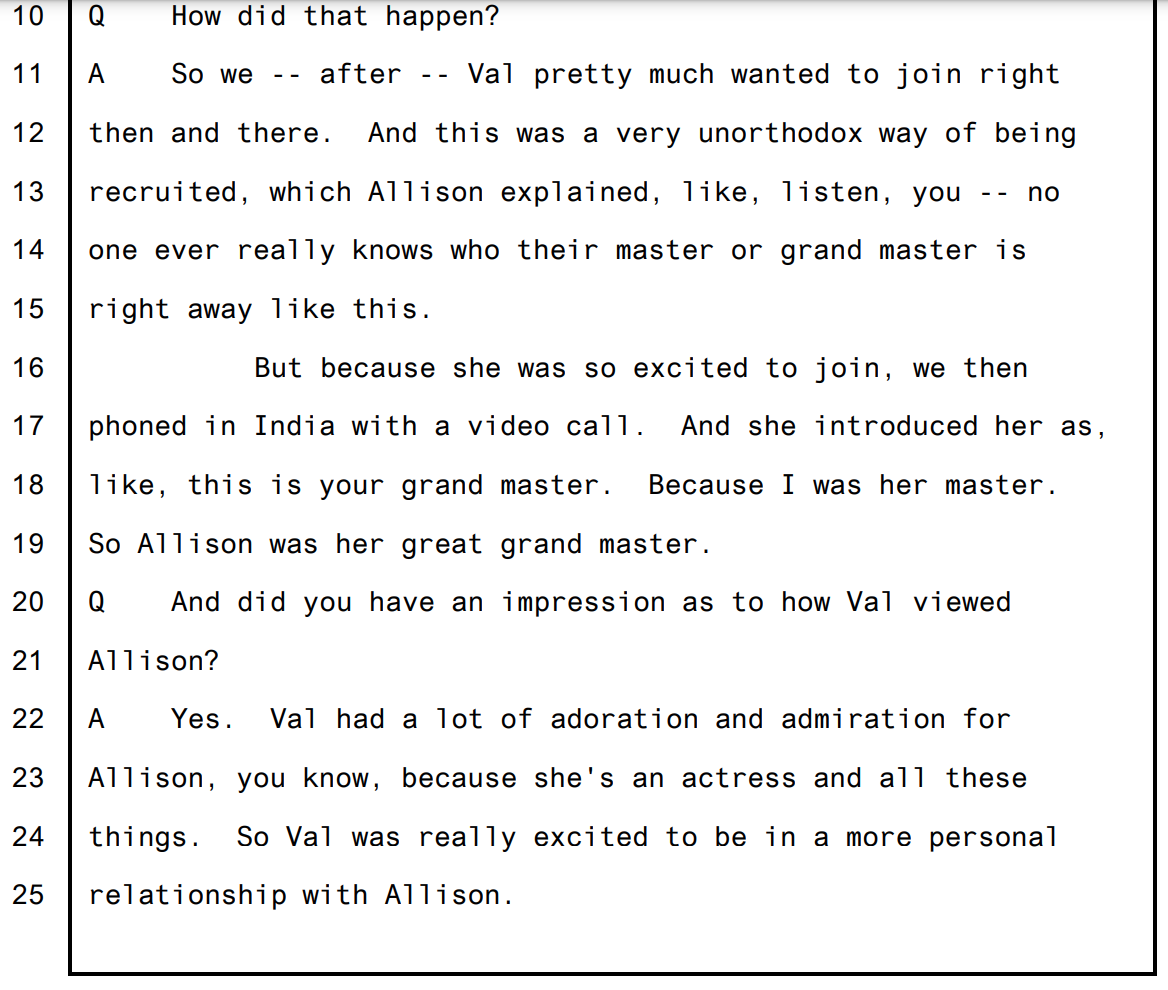
On recruiting Val
"Me and Val went to Vancouver together to do The Source program, where she met Allison. And I thought she would be good for it."
On Val's awareness
"She did say that it was a lifetime commitment, like a sorority."
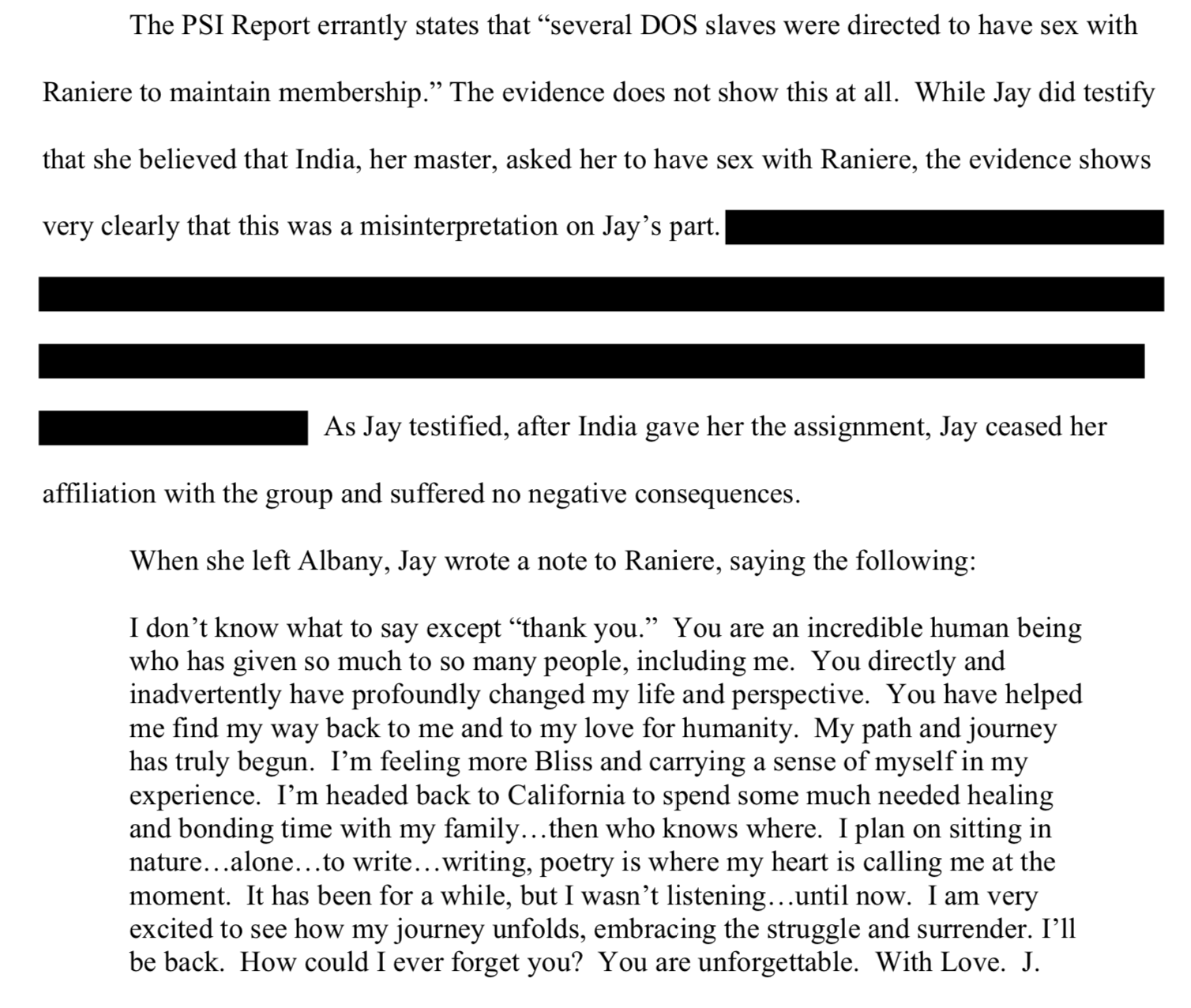
Joan's own trial testimony establishes that she left the group without negative consequence. The defense sentencing memorandum quotes that testimony directly. On her way out, she wrote Raniere a farewell letter. The letter is not ambiguous; it is reproduced in the sentencing record.
"I don't know what to say except 'thank you.' You are an incredible human being who has given so much to so many people, including me. You directly and inadvertently have profoundly changed my life and perspective… I'll be back. How could I ever forget you? You are unforgettable. With Love, J."
— Jessica Joan, farewell note to Keith Raniere, reproduced in the Defense Sentencing Memorandum, EDNY 18-CR-204, Dkt. 925, p. 43.
Why the comparison matters
The Kellen situation is genuinely difficult, and worth taking seriously. There is real moral weight in the question of how a society treats women who were both victimized and used as instruments of further victimization. Committee Chairman James Comer's instinct — that this can be both/and — is not a cheap one.
The NewsNation piece doesn't engage that difficulty directly. Instead, it imports a frame from elsewhere. The Epstein story lends its documented gravity to "NXIVM" through the analogy. And "NXIVM" lends its survivor-witness back to Epstein. (In the piece, "NXIVM" is functioning as shorthand for a single attempted-trafficking count, rooted in conduct inside DOS — a secret women's group distinct from NXIVM the self-help company.) Both stories are made to feel more legible by being placed next to each other, and the reader is invited to feel the satisfaction of explanation just by seeing them paired.
But the analogy is asymmetric in ways the piece does not mark. Epstein's record involves decades of sexual conduct with documented minors and significant financial flows. Raniere's convictions, including the trafficking counts, involve no convictions for him having sex with anyone, no money exchanged, and a federal jurisdictional theory that — on the trial's own record — relied on Joan's unrelated work travel and a "thing of value" defined as someone else's social standing.
When the two cases are framed as one pattern, the pattern's outline comes mostly from the Epstein side. The Raniere side is invited to sit quietly inside the silhouette.
From the analysis above.
A modest standard
There's a version of this story that would have served readers better. It would have introduced Joan with her name and her case, then briefly noted what Count 10 was. It would have acknowledged the Sylvie ruling. It would have separated NXIVM (the self-help company), DOS (a secret women's group, distinct from NXIVM), and the RICO indictment (a third thing — Raniere's informal "inner circle") instead of running them together. And it would have let Joan speak, in her own voice, about Kellen — without using her to make the unexamined claim that "NXIVM" and Epstein are two examples of the same thing.
That version would have done the harder thing: it would have allowed the Kellen question to remain a Kellen question, instead of resolving it by analogy.
This is the work that careful journalism on coercion has always had to do. It is the work of distinguishing what is known from what is felt; allegation from finding; verdict from record; one case from another. Survivors deserve that work. So do the people whose lives are still being shaped, today, by the verdicts those analogies harden.
The recognition between cases is real. It is sometimes also a shortcut. A reader's job — and a reporter's — is to know which one is operating in any given paragraph.
In the NewsNation piece, the analogy did the work. The record was never asked.
Frequently asked
What is the central claim of this analysis?
What was Count 10 in US v. Raniere?
What did the sentencing judge rule about a similar assignment carried out by "Sylvie"?
Is this article a defense of Keith Raniere?
Why does the comparison between NXIVM and Epstein matter for the Kellen story?
Citations & sources
- NewsNation, "NXIVM whistleblower: Kellen was a victim before she was a co-conspirator," May 2026
- Indictment (Second Superseding), United States v. Raniere et al., EDNY 18-CR-204, Dkt. 430
- Trial Transcript, June 10, 2019, Tr. 4325–4326 (Jay, direct — Lesko)
- Trial Transcript, June 10, 2019, Tr. 4343:22–4344:18 (Jay, direct)
- Trial Transcript, June 11, 2019, Tr. 4424, 4440 (Jay, direct)
- Trial Transcript (Jay, direct — Lesko), recruitment of Val
- Trial Transcript, June 17, 2019, Tr. 5414, 5418, 5419:6–7 (Government closing)
- Sentencing Transcript, EDNY 18-CR-204, October 27, 2020, at 11:8–13 (Garaufis, J.) — Sylvie ruling
- Defense Sentencing Memorandum, EDNY 18-CR-204, Dkt. 925, p. 43
- 18 U.S.C. §§ 1591, 1594(a)
- Judgment, EDNY 18-CR-204, Dkt. 969
Notes
- The three-element structure of the federal trafficking statute (interstate commerce; commercial sex act involving a "thing of value"; force, fraud, or coercion) is laid out at 18 U.S.C. §§ 1591, 1594(a). The application of those three elements to the facts of Count 10 — work travel as the commerce hook, social standing as the thing of value, DOS membership as the coercion — is what the analysis above asks readers to weigh. ↩︎
This piece compares a single news article against the underlying federal trial record. It is not a defense of any party; it is an argument for record-checking before analogy. Corrections welcome.